AliExpress by Alibaba.com

2 Sept 2014

Saudis risk new Muslim division with proposal to move Mohamed’s tomb

Al-Masjid al-Nabawi mosque in Medina, Saudi Arabia, where the remains of the Prophet are housed Mohamed
One of #Islam’s most revered holy sites – the tomb of the Prophet Mohamed – could be destroyed and his body removed to an anonymous grave under plans which threaten to spark discord across the #Muslim world.

The controversial proposals are part of a consultation document by a leading Saudi academic which has been circulated among the supervisors of al-Masjid al-Nabawi mosque in Medina, where the remains of the Prophet are housed under the Green Dome, visited by millions of pilgrims and venerated as Islam’s second-holiest site. The formal custodian of the mosque is Saudi Arabia’s ageing monarch King Abdullah.

The plans, brought to light by another Saudi academic who has exposed and criticised the destruction of holy places and artefacts in Mecca – the holiest site in the Muslim world – call for the destruction of chambers around the Prophet’s grave which are particularly venerated by Shia Muslims.

The 61-page document also calls for the removal of Mohamed’s remains to the nearby al-Baqi cemetery, where they would be interred anonymously.

There is no suggestion that any decision has been taken to act upon the plans. The Saudi government has in the past insisted that it treats any changes to Islam’s holiest sites with “the utmost seriousness”.


But such is the importance of the mosque to both Sunni and Shia Muslims that Dr Irfan al-Alawi warned that any attempt to carry out the work could spark unrest. It also runs the risk of inflaming sectarian tensions between the two branches of Islam, already running perilously high due to the conflicts in Syria and Iraq.

Hardline Saudi clerics have long preached that the country’s strict Wahhabi interpretation of Islam – an offshoot of the Sunni tradition – prohibits the worship of any object or “saint”, a practice considered “shirq” or idolatrous.

Dr Alawi, director of the Islamic Heritage Research Foundation, told The Independent: “People visit the chambers, which are the rooms where the Prophet’s family lived, and turn towards the burial chamber to pray.

“Now they want to prevent pilgrims from attending and venerating the tomb because they believe this is shirq, or idolatry. But the only way they can stop people visiting the Prophet is to get him out and into the cemetery.”

For centuries Muslim pilgrims have made their way to Mecca in order to visit the Kaaba – a black granite cubed building said to be built by Abraham, around which al-Masjid al-Haram, or the Grand Mosque, is built, and towards which every Muslim faces when they pray.

This pilgrimage, or hajj, is a religious duty that has to be carried out at least once in a lifetime.
Many go on to make their way to the nearby city of Medina to pay their respects at the Prophet’s tomb.
Muslims Praying in Masjid Nabwi
Muslims waiting to pray at the tomb of the Prophet at al-Masjid al-Nabawi in 
Al-Nabawi mosque around the tomb has been expanded by generations of Arabian rulers, particularly the Ottomans. It includes hand-painted calligraphy documenting details of the Prophet’s life and his family. Dr Alawi said the plans also call for these to be destroyed as well as the Green Dome which covers the Prophet’s tomb.

The Prophet is venerated by both branches of Islam, Sunni and Shia. The strict Wahhabi sect is a branch of the Sunni faith, however, and removing the Prophet could further inflame tensions between the two groups .

The current  crisis in Iraq has been blamed on the Shia former Prime Minister Nouri al-Maliki’s sectarianism, which alienated the Sunni, leading to the uprising. Isis, also known as Islamic State, which holds swathes of Iraq and Syria, and which murdered the American journalist James Foley, is a Sunni organisation.

Mainstream Sunni Muslims would be just as aghast at any desecration of the tomb as the Shia, Dr Alawi said.

The Independent has previously revealed how the multibillion-pound expansion of the Grand Mosque has, according to the Washington-based Gulf Institute, led to the destruction of up to 95 per cent of Mecca’s millennium-old buildings. They have been replaced with luxury  hotels, apartments and  shopping malls.

King Abdullah has appointed the prominent Wahhabi cleric and imam of the Grand Mosque, Abdul Rahman al-Sudais, to oversee the expansion project – necessary to cope with the huge number of pilgrims who now visit each year.

Dr Alawi says the consultation document for the al-Nabawi mosque in Medina, by the leading Saudi academic Dr Ali bin Abdulaziz al-Shabal of Imam Muhammad ibn Saud Islamic University in Riyadh, has been circulated to the Committee of the Presidency of the Two Mosques.

Several pages of the consultation document have just been published in the presidency’s journal. They call for the destruction of the rooms surrounding the tomb – used by the Prophet’s wives and daughters, and venerated by the Shia because of their association with his youngest daughter, Fatima.

The document also calls for the Green Dome, which covers the tomb and these living quarters, to be removed, and the ultimate removal of the Prophet’s body to a nearby cemetery.

The al-Baqi cemetery already contains the bodies of many of the Prophet’s family, including his father who was removed there in the 1970s, Dr Alawi said. In 1924 all the grave markers were removed, so pilgrims would not know who was buried there, and so be unable to pray to them.

“The Prophet would be anonymous,” Dr  Alawi added. “Everything around the Prophet’s mosque has already been destroyed. It is surrounded by bulldozers. Once they’ve removed everything they can move towards the mosque. The imam is likely to say there is a need to expand the mosque and do it that way, while the world’s eyes are on Iraq and Syria. The Prophet Mohamed’s grave is venerated by the mainstream Sunni, who would never do it. It is just as important for the Shia too, who venerate the Prophet’s daughter, Fatima.

“I’m sure there will be shock across the Muslim world at these revelations. It will cause outrage.”

The Independent was unable to contact the Saudi Arabian embassy, but it said in a statement last year: “The development of the Holy Mosque of Makkah al-Mukarramah [Mecca] is an extremely important subject and one which the Kingdom of Saudi Arabia, in its capacity as custodian of the two holy mosques, takes with the utmost seriousness. This role is at the heart of the principles upon which Saudi Arabia is founded.” Independent News

1 Sept 2014

Untraceable returning jihadists pose ‘serious threat’ to US

Unknown Jihadists pose
An image grab taken from a propaganda video uploaded on June 11, 2014 by jihadist group the Islamic State of Iraq and the Levant (ISIL) allegedly shows ISIL militants driving at an undisclosed location in Iraq's Nineveh province. (AFP Photo)
US #jihadist fighters returning from conflict zones pose a “very serious threat” to #US national security alongside British and Canadian nationals that also fought oversees as they can freely enter the American soil, top politicians say.

It is impossible to track every single person who might have visited a conflict zone such as Syria or Iraq, chairman of the House Intelligence Committee, Mike Rogers said, expressing concerns over American, British and Canadian jihadist fighters who potentially can pose a very serious threat to the US.

“I'm very concerned because we don't know every single person who has gone and trained and learned how to fight,” Rogers told Fox News Sunday, urging the White House to aggressively prosecute Americans who had trained overseas.

Hundreds of US citizens had gone overseas, Rogers said, in addition to some 500 British citizens and hundreds more from Canada.

“The chances of error are greater than our ability to track every single area. It's a very serious threat,” he said.

Meanwhile, he noted, the US is tracking “pretty serious” threats of planned attacks in the West by al-Qaeda.

Another member of the House Intelligence Committee, Representative Dutch Ruppersberger, echoed Rogers' assessment.

“The biggest threat that I see to the United States right now are Americans and Brits who have passports that have the ability to come into our country without getting a visa,” Ruppersberger told CNN's State of the Union program.

“We had the suicide American bomber who was radicalized, came home to visit his parents, went back and then killed himself. Now, that could have happened in the United States,” Ruppersberger said, referring to a man who became first known US suicide bomber after blew himself up in an attack in Syria in May.

On Saturday, US Secretary of State John Kerry called for an international coalition to combat the Islamic State and its “genocidal agenda” on a larger scale, as the US continues to hit jihadist positions in Iraq in limited airstrikes. RT

Celebration in Liberia slum as Ebola quarantine lifted

Ebola quarantine measures lifted by Govt
Residents of West Point celebrate the lifting of a quarantine by the Liberian government, in Monrovia August 30, 2014. REUTERS/2Tango
Monrovia/Conakry,(Reuters) – Crowds sang and danced in the streets of a seaside neighborhood in #Liberia on Saturday as the government lifted quarantine measures designed to contain the spread of the deadly #Ebola virus.

Faced with the worst Ebola outbreak in history, West African governments have struggled to find an effective response. More than 1,550 people have died from the hemorrhagic fever since it was first detected in the forests of Guinea in March.

Residents of the impoverished seaside district of West Point in Monrovia were forcibly cut off from the rest of the capital in mid-August after a crowd attacked an Ebola center there, allowing the sick to flee.

The quarantine sparked protests and security forces responded with tear gas and bullets, killing a teenaged boy.

But at dawn on Saturday, the community woke up to find the soldiers and barricades gone.

“I tell God thank you. I tell everyone thank you,” said Koffa, a female resident of West Point. Others danced in the streets chanting slogans like “we are free” while others rolled about on the asphalt pavement in celebration.

President Ellen Johnson-Sirleaf, a U.S.-educated Nobel Peace Prize winner, has sought to quell criticism of the government’s response by issuing orders threatening officials with dismissal for failing to report for work or for fleeing the country, and has ordered an investigation into the West Point shooting.

Liberia, where infection rates are highest, plans to build five new Ebola treatment centers each with capacity for 100 beds, government and health officials said on Saturday.

In neighboring Sierra Leone, President Ernest Bai Koromo dismissed his health minister Miatta Kargbo on Friday over her handling of the epidemic which has killed more than 400 people there.

Her replacement Abubakarr Fofana on Saturday confirmed that a third doctor in the county had died from Ebola, further hampering its ability to respond to the outbreak.

“It is with a deep sense of sadness that we have lost one of our finest physicians in the line of duty at a time like when we need a lot of them to help in out fight against Ebola,” he said.

Physician Dr. Sahr Rogers caught the disease while treating outpatients in the same hospital where a doctor died last month and where British nurse William Pooley was also infected.

SPREAD TO SENEGAL

Transmitted through the vomit, blood and sweat of the sick, Ebola has also spread to Nigeria and Senegal, which reported its first confirmed case on Friday – a Guinean student who was lost to authorities in his own country while under surveillance.

“His brother came from Sierra Leone where he was infected and has died. Shortly afterwards, this student left for Senegal,” said Dr. Rafi Diallo, spokesman for the Guinean health ministry.

Two other members of his family – his sister and mother – have died from Ebola, Guinean health ministry sources said.

A resident in the suburb of the Senegalese capital Dakar where the student resided said on Saturday that a team of health ministry officials wearing white protective suits and masks came to spray disinfectant at his home and a local grocer’s shop.

Many Dakar residents worry that the student could have spread the highly contagious virus in the three weeks since he was last reported in Guinea.

In Nigeria, where an infected traveler collapsed after arriving the Lagos airport, there have so far been 19 suspected, probable and confirmed cases and seven deaths.

“To avoid a situation like Nigeria, they need to be able to follow hundreds of contacts,” said epidemiologist Jorge Castilla of the European Commission’s Humanitarian Aid and Civil Protection Department in Dakar. “Whatever they do, there will probably be a second set of sick people as this guy has been here for some time.”

Senegal has since closed its land border with Guinea and halted flights to Guinea, Sierra Leone and Liberia, defying advice from the World Health Organization (WHO) that there is no need for travel restrictions.

A note from the WHO and the International Civil Aviation Organization sent to health ministries on Aug. 29 said: “Lives are being unnecessarily lost because health care workers cannot travel to the affected countries, and delivery of life saving equipment and supplies is being delayed.”

The World Food Programme said it needs to raise $70 million to feed 1.3 million people at risk from shortages in the Ebola-quarantined areas in West Africa, with the agency’s resources already stretched by several major humanitarian crises. MB

Top Chinese official heckled by Hong Kong protesters

Protest in Hong Kong
A protester shouts slogans at a pro-democracy rally next to the Hong Kong government complex, on August 31, 2014 (AFP Photo/Alex Ogle)
Hong Kong (AFP) - A senior #Chinese official was angrily heckled by #HongKong protesters Monday as he tried to defend Beijing's landmark decision to control which candidates can stand in the city's next leadership election.

Li Fei, a member of the top committee of China's rubber stamp parliament, was forced to speak over the cries of pro-democracy lawmakers and protesters during a meeting with local officials in the southern Chinese city.

His visit comes a day after the standing committee of the National People's Congress announced that although Hong Kong's next chief executive will be elected by popular vote in 2017, candidates must be backed by more than half the members of a "broadly representative nominating committee".

Democracy activists have called the restrictive framework a betrayal of Beijing's promise to award Hong Kong universal suffrage and have vowed an "era of civil disobedience" including mass sit-ins.

They say the nominating committee would ensure a sympathetic slate of candidates and exclude opponents of Beijing.

As Li approached the lectern to speak at the Asia World Expo convention centre, veteran dissident lawmaker Leung Kwok-hung started shouting him down, his fist raised in the air.

He was then joined by a dozen pro-democracy lawmakers and some younger demonstrators who unfurled a banner in front of the lectern where Li was speaking from and chanted: "The central government broke its promise, shameless."

The meeting was briefly suspended while security officers removed the hecklers.

Li flew into Hong Kong from Beijing late Sunday and was forced to drive past a crowd of largely student protesters who had gathered outside his hotel in the kind of scenes that would be unthinkable on the Chinese mainland.

Britain handed Hong Kong back to China on July 1, 1997 under a "one country, two systems" agreement which allows residents civil liberties not seen on the mainland, including free speech and the right to protest.

Following Beijing's decision to vet candidates, the pro-democracy group Occupy Central said Sunday it would go ahead with its threat to take over the city's Central financial district in protest, at an unspecified date. AFP

30 Aug 2014

First Ebola case in Senegal, five more states at risk of outbreak spread

First Ebola Case in Senegal
Reuters / China Daily
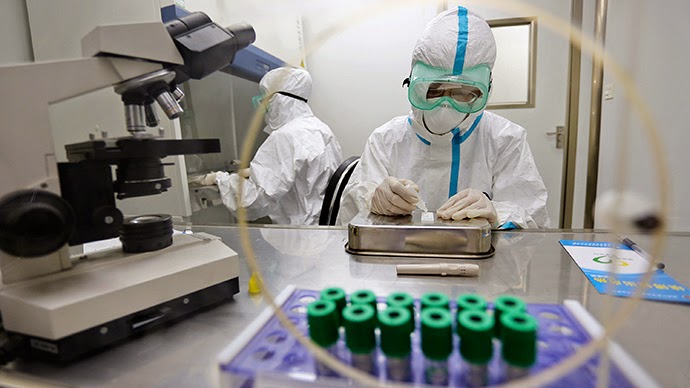
West African state of Senegal has become the region's fifth country to confirm a case of the #deadly #Ebola virus that has killed more than 1,500 people with the #WHO warning that five more states are at risk for spread of the outbreak.

A university student from neighbouring Guinea first asked for medical treatment in Dakar on Tuesday but gave no sign of Ebola, Health Minister Awa Marie Coll Seck told reporters. The student was quarantined the next day after scientists in Guinea notified Senegalese authorities that they are unaware of whereabouts of one person who had had contact with sick people, Seck said.

Seck told the press that the student's condition is “satisfactory,” after being tested positive with the deadly virus, but it is still unclear when or how the new victim came to Senegal after the country sealed off its border with Guinea last week. The World Health Organisation has been alerted of the new case.

Meanwhile, some 160 people are being monitored in Nigeria’s Port Harcourt after a doctor died from the virus on Thursday.

The Ebola outbreak ravaging West Africa began last year in Guinea. Since then, the disease has spread to Liberia, Sierra Leone and Nigeria and now Senegal. Five more countries were identified as at risk of contracting the virus, the United Nations World Health Organization (WHO) said on Friday.

“The following countries share land borders or major transportation connections with the affected countries and are therefore at risk for spread of the Ebola outbreak: Benin, Burkina Faso, Côte d’Ivoire, Guinea-Bissau, Mali, and Senegal,” the agency said, adding it will aid the new states with “surveillance, preparedness and response plan.”

Ebola Case in Senegal
Reuters / Misha Hussain
The Ebola Response Roadmap Situation Report 1 is the first update issued by the WHO following Thursday's release of an Ebola response roadmap that aims to stop the spread of the virus within six to nine months. According to the latest UN statistic almost 40 percent of the reported cases have occurred within the past three weeks, and warned that eventually 20,000 people could be infected.

“There are serious problems with case management and infection prevention and control,” the report said. “The situation is worsening in Liberia and Sierra Leone.”

As individual African states battle the virus, the health minister Miatta Kargbo of Sierra Leone has been dismissed by the country's president “to create a conducive environment for efficient and effective handling of the Ebola outbreak,” that has killed more than 400 people in that country alone.

The latest official number of Ebola cases in Guinea, Liberia, Nigeria, and Sierra Leone stands at 3,069, with over 1,552 deaths, making this the largest Ebola outbreak ever recorded, WHO said.
The head of French Medecins Sans Frontieres (MSF), Mego Terziam, believes the WHO doesn’t have enough resources to stop Ebola from spreading.

“I am extremely pessimistic if there is not a substantial international mobilisation,” Terziam said. “Organisations like the WHO and MSF will be not capable to mobilise additional human resources, additional logistics in order to control the epidemic.”

In order to get ready for the worst possible scenario and help those already suffering, researchers are moving forward with trials of experimental Ebola vaccines, but the first results are unlikely before the year end.

‘All hands on deck’: US pushes ahead with Ebola vaccine trials on humans

With the spread of Ebola, the WHO has deemed it ethical to try out experimental drugs that show promise in curing the decease, as there are no approved Ebola vaccines or treatments. RT

Putin, defiant toward West, likens Ukraine conflict to WWII

Vladimir Putin
Russian President Vladimir Putin during a visit Friday to the youth educational forum at Lake Seliger, in the Tver region northwest of Moscow. (Mikhail Klimentyev / Associated Press)
Evoking startling images of siege and empire, Russian President Vladimir #Putin on Friday struck a defiant pose over the deployment of troops and tanks in eastern #Ukraine, declaring that Russia has no plans for “large-scale conflicts” but reminding the #world that he presides over a nuclear-armed state.

“It's best not to mess with us,” Putin said, referring to Russian separatist fighters in Ukraine with a term that dates back to the era of the Russian empire — “New Russia militia” — and likening their battle with Ukrainian army forces to Soviet citizens' heroic resistance during the German Nazi siege of Leningrad.

His comments, designed to cast the Ukraine conflict as a World War II-like aggression inspired by the West, came a day after President Obama warned of the mounting costs to Russians as their government deepens its involvement in eastern Ukraine.

The Obama administration's new appeal to Russian public opinion probably reflects growing doubt that the U.S. can bring Putin to the negotiating table over Ukraine, as the Kremlin leader wages his own campaign designed to stoke Russians' nationalist pride and nostalgia for its the lost superpower status.

“Thank God, I think no one is thinking of unleashing a large-scale conflict with Russia. I want to remind you that Russia is one of the leading nuclear powers,” Putin said during a visit to a Kremlin-sponsored youth camp, clearly aiming to marshal public support for a military campaign that has brought international isolation and increasingly stringent economic sanctions.

Obama on Thursday warned that stricter sanctions would be forthcoming after NATO released satellite surveillance images showing Russian armored columns crossing into southeastern Ukraine.

And the U.S. ambassador to the United Nations, Samantha Power, called up images of the human cost likely to be borne by the Russian military south of its borders. “In Russia, family members of Russian soldiers are holding funerals for their loved ones who have been killed in the fighting in Ukraine,” she told the U.N. Security Council on Thursday.

The U.S. is playing on growing Russian fear that the March annexation of Ukraine's Crimea region, which boosted Putin's approval ratings to record heights, could lead to a bloody and lengthy war.

The U.N. on Friday reported that the death toll in Ukraine as of Wednesday had risen to at least 2,593 since fighting between separatists and government troops escalated in mid-April. The report from the Office of the High Commissioner for Human Rights blamed all parties in the conflict for inflicting “intolerable hardships” on civilians, who are being killed at a rate of 36 a day.

State Department officials said this week that the Russian military was sending troops 30 miles into Ukraine, while concealing that fact from them and their families. Also undisclosed, officials said, was the presence in St. Petersburg hospitals of soldiers wounded in Ukraine.

Steven Pifer, a former U.S. ambassador to Ukraine, noted a report in a Russian newspaper that authorities had gone so far as to move the graves of two Russian paratroopers killed in Ukraine to conceal their deaths from the public.

Reporters for several independent news sites in Russia said they ran into trouble while checking relatives' reports that paratroopers who had been killed in fighting near Luhansk had been buried secretly near Pskov. The reporters said they were chased away by beefy men who appeared to be with the security services.

If casualties do begin to accumulate, “that could undermine the entire basis of public support for what Putin's doing,” said Pifer, who is now with the Brookings Institution.


But the costs to Russian society for backing the separatists aren't yet apparent to most Russians, who have applauded the Kremlin's annexation of Crimea and its defense of Russians' rights in former Soviet republics that are now sovereign states.

U.S. reliance on sanctions as a tool for stirring public opposition to Putin's Ukraine policies has so far helped the Kremlin cast Washington as the perpetrators of any economic damage the country is suffering.

Though some polls show that many Russians — 90% in one survey — oppose a war in Ukraine, there are significant signs of continuing public hostility toward Western influence in the neighboring nation.

Washington's Pew Research Center said an early August survey by the Moscow-based Levada Center found that 77% of respondents in Russia believed the Ukrainian government's military operation to recover territory from the separatists was launched at the encouragement of the United States.

As many as 52% believed that Ukraine had “become a puppet in the hands of the West and the U.S.A., who are pursuing an anti-Russia policy,” the poll found in a question that asked respondents to evaluate why the new leadership in Ukraine preferred to ally with the European Union over a Kremlin-controlled trade group.

“The story that comes through to you if you're the average Russian is that it's the Americans egging on this Ukrainian Nazi junta to attack peaceful civilians in eastern Ukraine,” said Olga Oliker, associate director of Rand Corp.'s International Security and Defense Policy Center.

In the Kremlin view, Russia is a brave force willing to stand up to the West to protect Russian speakers in eastern Ukraine from repression and to withstand the unjust sanctions imposed on it for its noble actions, Oliker said.

Putin clearly sought to reinforce that narrative Friday as state television cameras captured his choreographed exchange with the young campers.


“Small villages and large cities are surrounded by the Ukrainian army, which is directly hitting residential areas with the aim of destroying the infrastructure,” he said. “It sadly reminds me of the events of the Second World War, when German fascist ... occupiers surrounded our cities.”

EU foreign ministers meeting Friday in Milan debated calls for stepping up economic sanctions on Moscow, which to date have targeted a few dozen Kremlin officials and tightened Russia's access to international financial institutions.

“We have to be aware of what we are facing: We are now in the midst of a second Russian invasion of Ukraine within a year,” said Swedish Foreign Minister Carl Bildt, referring to Russia's seizure of Crimea. Citing the Russian forces' opening of a new front along Ukraine's Sea of Azov this week, Bildt said Russia's hand in the Ukraine violence was indisputable and that it was time “to call a spade a spade.”

European Commission President Jose Manuel Barroso called Putin on Friday to condemn the “significant incursions into and operations on Ukrainian soil by Russian military units” and warned that further intrusions would “carry high costs,” his office reported. The LA Times

TALIBAN ATTACK INTEL OFFICE IN EASTERN AFGHANISTAN

Taliban Intelligence Office under attack
Afghan security forces inspect the site of a suicide attack in Jalalabad, east of Kabul, Afghanistan, Saturday, Aug. 30, 2014. A suicide bomber in a truck blew himself up at an intelligence headquarters in eastern Afghanistan on Saturday, setting off an intense firefight with security forces, officials said. (AP Photo)
KABUL, Afghanistan (AP) -- A suicide bomber in a truck blew himself up at an intelligence headquarters in eastern Afghanistan on Saturday, killing at least two people and setting off an intense firefight with security forces, officials said.

After the bombing outside the headquarters of the National Directorate of Security in Jalalabad, militants battled with security forces for an hour before authorities were able to put down the attack, said Ahmad Zia Abdulzai, a spokesman for the Nangarhar governor.

He would not say how many attackers were involved or whether they were all killed or some escaped. He said authorities were searching the grounds.

Abdulzai put the death toll at two and said they were both from the NDS, but Najibullah Kamawal, the top provincial health official, said six bodies had been brought to the hospital.

Conflicting death tolls are common in the immediate aftermath of such bombings.

Kamawal said 45 people were wounded. The powerful explosion shook the entire neighborhood, breaking nearby windows and startling residents.

"It was early morning and we were sleeping at home. A strong explosion happened followed by firing. When I came out of my room I was covered with dust, and my kids and I got injured from broken windows," said Ahmad Shah.

A spokesman for the Taliban, Zabihullah Mujahid, claimed responsibility for the attack in a telephone call to The Associated Press.

Jalalabad is one of Afghanistan's biggest cities, sitting on a major trade route into neighboring Pakistan. But the city is also located in one of the country's most troubled regions.

Taliban militants are easily able to hide in the forbidding, mountainous terrain, and often cross back and forth into neighboring Pakistan. Afghan security officials have repeatedly accused Pakistan of giving sanctuary to militants that attack Afghanistan, something Pakistan denies.

In May, militants attacked the provincial justice building in Jalalabad, killing at least five civilians before authorities were able to retake the building. Militants in March attacked a police station in Jalalabad, sparking a four-hour battle with police that ended with eleven people dead.

This is the first year that Afghan security forces have operated largely on their own, without U.S. or international forces. The NATO-led security force is scheduled to withdraw from Afghanistan by the end of the year, although a small number of U.S. and international troops may stay behind to advise and assist the Afghan forces. But that is contingent on Afghanistan signing a security arrangement with the U.S., something President Hamid Karzai has so far refused to do.

Both of the men vying to replace him in the country's presidential election have said they will sign the agreement, but that has been stalled as the winner from the disputed vote has still not been named.

--

Associated Press writer Rebecca Santana contributed to this report.

27 Aug 2014

Answers to journalists’ questions following working visit to Belarus

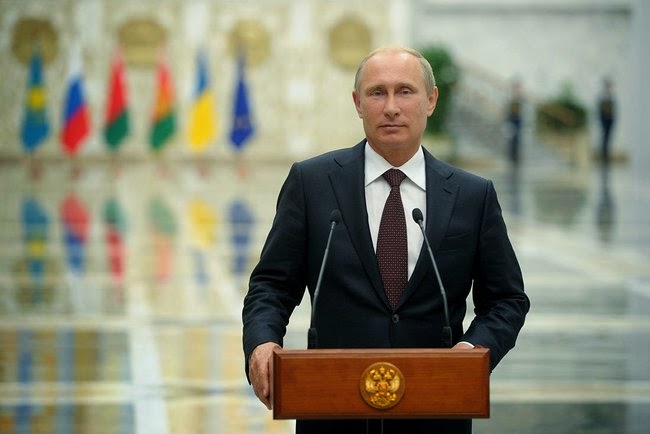
Russian President Vladimir Putin in Belarus
 Answers to journalists’ questions following a working visit to Belarus.
QUESTION: Mr Putin, what did you discuss with Mr Poroshenko? How did the discussion go?

VLADIMIR #PUTIN: We talked about the whole range of issues in #Russian-#Ukrainian relations, first and foremost, economic cooperation, taking into account that in the expanded meeting, we also talked primarily about this, as well as the situation that has unfolded in Ukraine. We certainly could not avoid this topic. We discussed the need to end bloodshed as quickly as possible, the need to transition to a political settlement of the problems, the whole range of problems, that Ukraine is facing in its southeast region.

For its part, Russia will do everything to promote this peace process if it is launched, and in our view, this process needs to be launched as soon as possible. In this regard, an agreement has been reached – this was during the expanded format meeting, and we confirmed it during our bilateral meeting – that the contact group must renew its work as quickly as possible, perhaps here in Minsk.

Both President Poroshenko and I feel that we need to renew our dialogue on energy, including the gas issue. Frankly, this is a difficult issue, it is in a deadlock, but we still need to talk about it. We agreed that we will renew those consultations. That’s the short version.

QUESTION: Mr Putin, what about the outcome of the five-party meeting with EU representatives, with your Customs Union colleagues and with Mr Poroshenko?

VLADIMIR PUTIN: Overall, I give it a positive assessment. I think this meeting in that format was useful. Granted, I do not know how it will all turn out. But in any case, we had another chance to express our concerns. We agreed that we will intensify efforts in the trilateral working group of Russia, Ukraine and EU representatives and will try to draft proposals by September 12, if we can, regarding the concerns expressed by Russia and the Customs Union that I talked about.

We once again pointed out to our partners – both European and Ukrainian partners – that implementation of the association agreement between Ukraine and the EU carries significant risks for the Russian economy. We have shown this in the text of the agreement, directly pointing to specific articles in that agreement.

Let me remind you that this concerns nullifying Ukraine’s customs tariffs, technical regulations, and phytosanitary standards. The standards in Russia and Europe currently do not correspond. But, as you recall, the most classic example is the introduction of EU technical regulations in Ukraine. In that case, we would not be able to supply our goods to Ukraine at all. We have different technical standards. And according to the European Union’s standards, we will not be able to supply our machine-building products there, or any industrial goods. If that happens, we cannot accept Ukrainian agricultural production goods in our territory, because we have different approaches to phytosanitary standards. We feel that many problems would occur.

I must say that our colleagues do not agree with all my arguments, but in any case, we were heard and we agreed that we will intensify our exchange of opinions and try to find at least some resolutions. But I once again said that in order to avoid any surprises, we are constantly discussing this, including at the meeting in Deauville, as you know, where I also talked about this. If we do not achieve any agreements and our concerns are not taken into account, then we will be forced to take measures to protect our economy. And we explained what those measures would be. So our partners must weigh everything and make corresponding decisions. Each nation in this process has the right take any steps within the framework of its competence. All of us are sovereign states and we will respect any choice by our European and Ukrainian partners. We hope that they will treat our measures to protect our economy with the same respect.

QUESTION: Mr Putin, did you discuss the reports from Ukraine about the arrest of Russian paratroopers? If this is true, how did they end up there and what will Russia do about this?

VLADIMIR PUTIN: Yes, Mr Poroshenko mentioned this. But you know that Ukrainian service members have ended up on our side as well, and not just 5-10 of them, but dozens; last time, it turned out to be 450 people. I have not yet heard the report by the Defence Minister of the General Staff. But the first thing I heard is that they were patrolling the border, they may have ended up on the Ukrainian side. After all, Ukrainian service members entered our territory with armoured equipment, and we didn’t have any problems. I hope that in this case, there also will not be any problems with the Ukrainian side.

QUESTION: We were not officially told until the last minute whether you will have a bilateral meeting or not. But the meeting occurred. What was the reason, what circumstances served in favour of holding the meeting?

You talked about a ceasefire. Did you speak substantively about the conditions for a ceasefire to be possible?

VLADIMIR PUTIN: No. We did not discuss this matter substantively. Frankly speaking, we cannot discuss any conditions for a ceasefire or possible agreements between Kiev, Donetsk and Lugansk. This is not our business; it is a domestic matter of Ukraine itself. We can only support the creation of a environment of trust during this possible and, in my view, highly necessary negotiation process. We spoke about this. We spoke, where possible, about what Russia could do to make this process possible. But Russia did not impose any conditions. We cannot do that, we do not have any right to do so. This is a Ukrainian affair; it is up to Donetsk and Lugansk.

We expressed our concern with regard to the humanitarian component. That is true. And, indeed, President Poroshenko does not deny the complexity of the humanitarian situation. It cannot be characterised as anything other than catastrophic. We talked about the possibility – this is another topic, I did not mention it earlier – and the need to provide humanitarian assistance to Donetsk and Lugansk, and we agreed on how we will cooperate in this area. I will not get ahead of myself, but overall, we have certain agreements here as well. We will look into how to do this.

We talked about cooperating in various sectors. Why was this imperative? Currently, we are in a deadlock on the gas issue. You see, this is very serious matter for us, for Ukraine and for our European partners.

It is no big secret that Gazprom has advanced payment for the transit of our gas to Europe. Ukraine’s Naftogaz has returned that advance payment. The transit of our gas to European consumers was just about suspended. What will happen next? This is a question that awaits a painstaking investigation by our European and Ukrainian partners. We are fulfilling all the terms of the contract in full. Right now, we cannot even accept any suggestions regarding preferential terms, given that Ukraine has appealed to the Arbitration Court. Any of our actions to provide preferential terms can be used in the court. We were deprived of this opportunity, even if we had wanted it, although we already tried to meet them halfway and reduced the price by $100.

In other words, we have many specific issues to address and both Russia and Ukraine are interested in resolving these matters, as are our European partners. All this compelled us to meet bilaterally.

Thank you very much. Have a good evening. Kremlin.ru

24 Aug 2014

Rockets from Syria fired into Israeli-held Golan Heights, army says

Rocket Fired from Syria to Israel
Menahem Kahana, AFP | Israeli army tanks during a drill in the Golan Heights on May 19, 2014
Rocket fire from #Syria slammed into the #Israeli-occupied sector of the Golan Heights Sunday but there were no reports of casualties.

"At least five rockets fired from Syria hit different locations across the Golan Heights," the Israeli army said in a statement.

An army spokeswoman told AFP that it was not known who launched the rockets and the Israeli military did not return fire.

She said there were no casualties in the attacks, at around 1.30 am (2230 GMT) on Sunday, the 48th day of a war between Israel and the Islamist movement Hamas in and around Gaza.

Last month a rocket from Syria prompted Israeli artillery to shell Syrian army positions.

In June Israeli warplanes attacked Syrian military headquarters and positions after an Israeli teenager was killed in what the Jewish state said was a cross-border attack by forces loyal to the regime of Syrian President Bashar al-Assad.

Some previous incidents have been put down to stray fire from fighting between Syrian government troops and opposition forces.

Late on Saturday, a rocket fired from Lebanon hit northern Israel.

There was no immediate claim of responsibility for the launch or reports of damage or injuries.

A Lebanese security source said the rocket was fired from Dheira, three kilometres (nearly two miles) from the border with Israel.

The same source noted that Israeli helicopters were seen flying around the border area.

In mid-July, at least nine rockets were fired from Lebanon at the Jewish state, prompting Israel to retaliate with artillery fire.

Lebanese military officials had at the time said they believed the attacks were carried out by a small Palestinian group in an act of solidarity with Gazan militants.

Israel did not return fire for the Saturday night attack but sent "a strong protest" to the United Nations Interim Force in Lebanon, which monitors the border between Lebanon and Israel. AFP

22 Aug 2014

America’s adversaries crow over Ferguson shooting conflict

Protest in Ferguson

Usually, it is the United States that doles out rebukes over human rights abuses to the troublesome country of the day.

However the police shooting of an unarmed black teenager and subsequent crackdown on protesters in the Midwestern state of Missouri has America’s foes crowing about the flaws in the land of the free. Teargas, arrests of journalists, racial tensions and footage of militarily equipped police training their weapons on protesters. These are images more easily associated with one of the nations regularly chided by Washington than the small town of Ferguson, rocked by days of violent protests.

Many of the countries at the stinging end of these criticisms have seized upon the killing of 18-year-old Michael Brown and the ensuing clashes to scold the United States for hypocritically lecturing the world on human rights while ignoring the plight of its own people. They also say the shooting underscores how far America has to go to resolve its racial tensions.

In China, which Washington regularly accuses of human rights abuses, the Ferguson story has been getting prominent media coverage.
‘Human rights flaws’

In a commentary entitled “Ferguson riot reveals US racial divide, human rights flaw”, the official news agency Xinhua berated America.

It said the Ferguson shooting “once again demonstrates that even in a country that has for years tried to play the role of an international human rights judge and defender, there is still much room for improvement at home”.

“What the United States needs to do is to concentrate on solving its own problems rather than always pointing fingers at others,” it added.

While China censors reports of local unrest in its domestic media, state broadcaster CCTV has covered the Ferguson riots. On Tuesday, it showed National Guard troops on the streets, with a reporter taking advantage of the greater access available to media in the United States, describing tear gas and other weapons used by police.

On Chinese social media, some echoed the state media line. “This is human rights in democratic countries,” wrote one user of the Twitter-like Sina Weibo service.

But others noted the repression was light compared to that meted out to protesters by the Chinese government. In 1989, hundreds were killed during the armed suppression of protests in Beijing’s Tiananmen Square.

‘Oppressed’ Americans
Iran also latched on to the Ferguson story as evidence of the racial divide in America and what it called double standards on human rights.

“The targeted discrimination against the black in America by the US police and the judicial system and the suppression of protesters ... are clear instances of violations of human rights of people of colour in the US,” the foreign ministry said in a statement. Iran’s Supreme Leader Ali Khamenei tweeted: “Today like previous years, African-Americans are still under pressure, oppressed and subjected to discrimination.”

Even Egypt - where at least 1,400 people, mostly Islamist protesters, have been killed in clashes with security forces - weighed in. Interior ministry spokesman Hany Abdel Lattiff, said the US police were using “excessive” force. “The police are using heavy weapons that are used in war. We didn’t see the protesters even using Molotov cocktails or shotguns. They have legitimate demands.”

Egypt’s foreign ministry said Tuesday it was “closely monitoring” the situation in Ferguson and echoed a UN call for restraint. Russia, which has been under fire for months over its intervention in Ukraine and is a favourite target for allegations of authoritarianism, has also given the Ferguson story wide coverage.

Konstantin Dolgov, the foreign ministry’s representative for human rights, said the US should take care of its own problems before interfering in the affairs of other nations. He said the events in Ferguson “are clear evidence of the high degree of tensions in US society, which remains split along racial lines”.

It was a view echoed by rights group Amnesty International, which for the first time has deployed observers within the United States.

The “US can’t tell other countries to improve their records on policing and peaceful assembly if it won’t clean up its own human rights record,” the group wrote on Twitter. The irony of the situation was not lost on the Internet.

One website www.vox.com published a satirical take on how American media would cover the story if it were happening anywhere else in the world, referring to “a remote Missouri village that has been a hotbed of sectarian tension”.

Dramatic footage from the protests sweeping social media prompted reactions from activists in more troubled parts of the world.

Mariam Barghouti, a student from Ramallah in the West Bank, tweeted some advice to the Americans: “Keep calm when you’re teargassed, the pain will pass, don’t rub your eyes!”–AFP

PTI, PAT declares to react together against police action

Azadi March Protesters
PTI Azadi March in ISB

ISLAMABAD - Though two different crowds of Pakistan Tehrik-e-Insaf (PTI) and Pakistan Awami Tehreek (PAT) are sitting at the Constitution Avenue some feet away from each other, yet it looks both are ready to react together in case of any severe action from the government or law enforcement agencies.
It is not clear what is the binding force between the two of them or which force had bound both of them to protest separately but react together in case of any action from the government.

As the rumours of a police operation started spreading on Thursday noon, the leaders of the both protesting parties went on to say publicly that they would act together in case of any action taken against one of them.
PTI Chief Imran Khan was the first who came on the stage in the afternoon and said that he had conveyed a message to PAT Chief Dr Tahirul Qadri that in case of any police action against both of them or anyone of the protesting parties, both would act together and agitate against this action.

Addressing his speech in the day before a thin crowd, Khan said that the government has removed Inspector General of Police (IGP) Islamabad Aftab Cheema who had refused to obey illegal orders of the government. “He was dutiful police officer who heard the voice of his conscience and refused to take severe action against the protestors,” Imran said.

Imran said the government was planning a police operation early in the morning when the number of the crowd was thin. He said that Khalid Khattak had been made acting IGP Islamabad and asked, “Khalid Khattak hear your voice of conscience as the rulers will not live in Pakistan for a long time.

“But this is not the game of Khalid Khattak as this is the game of Secretary Interior Shahid Khan who is a courtier of Prime Minister Nawaz Sharif and has been given this post as a reward for rigging the election,” Khan alleged and warned secretary interior in a bizarre way to avoid any action against his workers otherwise he would not spare him. “In case of police attack on us, we will be united,” he stressed.

Khan said that on one hand, the government was talking about negotiations and on the other hand the police had started gathering here in the morning to start an action.

“Hear me the government of Nawaz Sharif, never try to do this foolish mistake,” he said
As Imran Khan ended his speech, the sound system of the PAT was switched on and a senior leader of the party said if the government took any police action against them or the PTI protestors, both of the protesting parties would act together. He said though both the parties were staging their separate sit-in, yet both were same in case of any action.

PTI Vice-chairman Shah Mahmood Qureshi in his speech said that the government was forcing the TV channels to stop their live coverage and asking them to remove their DSNG vans from the protest venue.
He said this would an attack on the freedom of expression. Similar kind of words came from the PAT about the freedom of expression after Qureshi’s speech. Nation News

16 Aug 2014

Ebola spreading faster, out of control for next 6 months – Doctors without Borders

Ebola Outbrake
A woman stands at a pharmacy next to a poster displaying a government message against Ebola, at a maternity hospital in Abidjan August 14, 2014 (Reuters / Luc Gnago)
The spread of #Ebola is outrunning efforts to stop it, according to international aid group Doctors Without Borders, which estimates it might take six months to get the situation under control.

The chief of the French-founded group, also known as Médecins Sans Frontières (MSF), Joanne Liu, spent 10 days in the disease-hit regions of West #Africa, before voicing her conclusions at a Friday press conference in Geneva.

"[Ebola] is deteriorating faster, and moving faster, than we can respond to," she told reporters.

The deadliest ever outbreak of Ebola has already claimed 1,145 lives, according to official figures, which could in fact “vastly underestimate” the real magnitude of the disaster, the World Health Organization warned a day earlier.

"It is like wartime," Liu said. "It's moving, and advancing, but we have no clue how it's going. Like in wartime, we have a total collapse of infrastructure."

She gave as an example a 40-bed treatment center in Liberia, where 137 people are being cared for. Overcrowded facilities there are “absolutely dangerous," Liu said.

"With the massive influx of patients that we had over the last few days, we're not able to keep zones of patients anymore. Everybody is mixed," she said.

Overcrowded hospitals do not mean all of those suspected of being infected go there. Superstitions and fears make many in African villages hide their sick relatives at home.

The new Secretary General of the International Federation of Red Cross and Red Crescent Societies (IFRC), Elhadj As Sy, who has also traveled to the Ebola-struck region, said in a Friday statement that “tackling fears, ignorance and stigma” surrounding the disease in the local African communities was a major challenge for IFRC volunteers.
As Sy said it was also “particularly important to stop more healthcare workers in the affected areas from getting infected.”
Sierra Leone's president, Ernest Bai Koroma, told journalists Friday that the country has lost two doctors and 32 nurses to Ebola.

"We need specialized clinicians and expertise, and that is why we are appealing to the international community for an enhanced response to our fight" against Ebola, he said, AFP reported.

Overall in the four affected countries, 80 healthcare workers died of Ebola. While 170 were infected, according to Doctors Without Borders.

Liberia's president, Ellen Johnson Sirleaf, expressed regret Saturday over the high death toll among the country's healthcare workers who have fought the Ebola outbreak, Reuters reported.

Meanwhile in Nigeria, where three people have died of Ebola, while 169 are being checked for possible infection, the president has decided to sack 16,000 doctors who participated in a strike for better working conditions, Nigeria’s Premium Times reports.

News of the country’s medical staff being sacked amid fears of epidemic spreading has resulted in a massive online outcry with some of the users blaming the government for untimely sacking of doctors while others blaming doctors for an untimely strike.
Authorities of the worst-hit country, Liberia, fear that hunger could become a by-product of the epidemic, as there are not enough food supplies in the quarantined areas.

Liberia has requested emergency food aid from donors.

"We can establish as many checkpoints as we want, but if we cannot get the food and the medical supplies into affected communities, they will leave," Information Minister Lewis Brown said, Reuters reported. "We can't ask our people to starve."

Brown has also criticized the international community for its slow response to the Ebola crisis.

"The reaction quite frankly is not where we would want it to be to give any serious level of comfort," he said.  RT

15 Aug 2014

Chinese police ‘fire on Tibetan protesters’

Tibetan Protesters
There are Tibetan communities outside Tibet, like this one in Shanba town, Sichuan
Ten people were injured when #Chinese police opened fire on #Tibetan protesters demonstrating against the detention of a village leader, two activist groups and overseas news reports say.

The incident is said to have taken place on Tuesday in Sichuan province's Ganzi prefecture, also known as Kardze.

Arrests were also made and some people fled, the activist groups said.

The incident does not appear to have been reported in Chinese state media.

Obtaining independent confirmation of events both in Tibet and in ethnic Tibetan areas in surrounding regions is extremely difficult.

Both access to these areas and information flow out of them is tightly controlled.

Chinese state media does confirm some of the incidents but not all. Accounts from activist groups have proved reliable in the past.

Armed police

According to UK-based group Free Tibet, a village leader named Wangdak was arrested on Monday over a dispute with local authorities.

The group said the row related to alleged harassment of female members of a dance troupe at a celebration villagers had been ordered to stage for senior officials.

The US-based International Campaign for Tibet said it also related to a dispute over official restrictions on a traditional gathering at a local horse festival.

After Mr Wangdak was detained, a crowd of Tibetans gathered to protest.

Both groups said armed police were deployed, used tear gas and then opened fire.

Mr Wangdak's son was among those who were shot, both activist groups said.

Free Tibet said at least two people were shot but the nature and cause of the other injuries was not clear.

The village was now surrounded and many adults had gone into hiding, Radio Free Asia reported, citing a Tibetan exile monk. BBC

Snail-paced marchers snowballing on capital

Azadi March by PTI
Azadi March by PTI Going to Islamabad

LAHORE - Chanting slogans of change and waving banners, high-spirited marchers of PTI and PAT set off for the capital late Thursday night with dreams of changing the system.

PTI chairman Imran Khan and PAT chief Dr Tahirul Qadri led two separate processions from Lahore and attracted larger crowds as they headed towards Ravi Bridge on their way to Islamabad.

Imran Khan set out with the aim of making Prime Minister Nawaz Sharif to resign from his office and Dr Qadri left his Model Town residence pledging to restore real democracy.

“I ask you to resign, Mr Prime Minister, before the Azadi March reaches Islamabad”, said Imran Khan as he led thousands of party activists from his Zaman Park residence. He also demanded resignation from Election Commission members for allegedly assisting the ruling party in stealing people’s mandate in 2013 polls.

Imran covered 4km distance from his residence to Faisal Chowk, the main venue of the drive, in more than six hours. Imran’s sons Qasim and Suleman besides his other close relatives were also with him on a specially prepared container.

Mr Qadri wished the countrymen a happy Independence Day before leaving from his residence.
“The Revolution March will ensure constitutional and democratic rights to the oppressed of this country,” he said.

In case of Azadi March it was pre-decided that PTI workers would be allowed to move out, but government initially had a different policy vis-à-vis PAT activists. It was after prolonged negotiations with Dr Qadri involving MQM chief Altaf Hussain, Sindh Governor Ishratul Ebad and Punjab Governor Ch Sarwar that Revolution March was allowed to proceed. The PAT chief held out assurance to the mediators that he would keep the march peaceful.

Imran launched his long march from his Zaman Park residence at 1pm, after offering special prayer along with the marchers for their success. PTI top leaders including Shah Mehmood Qureshi, Javed Hashmi, Asad Umer, Ijaz Ch, Dr Arif Alvi, Naeemul Haq and Shafqat Mehmood were also on the container. A bullet-proof vehicle closely followed the special container which was to be used by party chief if needed.

Addressing the charged party workers after reaching Faisal Chowk, Imran said: “I brought victory for the people of Pakistan in the World Cup and I will win the match in Islamabad to restore real democracy in the country.” He said the people of Lahore by joining the Azadi March have established that electoral match of 2013 was fixed.

The PTI chairman said he would die for the cause of freeing the working classes from the slavery of dynastic politics, and he asked the people living along GT Road and beyond it to join the Azadi March on its way if they desired a real change.

Imran while saying that he was going to create a new Pakistan warned that any Gullu Butt confronting PTI march would be held accountable and sent to jail when PTI would be voted to power. Calling the ruling family and their close associates a group of Gullu Butts, he warned they would be put behind the bars for their crimes to end Gullu Butt culture for good.

“I will reach with a million marchers to the capital and get resignation from the prime minister,” Imran declared. He said: The ruling family kings are preparing their princes and princesses to enslave the masses but I will not let them do so. My sons will not dictate the affairs of the state if PTI will be voted to power.

The PTI chief also pledged: I will not maintain my assets abroad but bring the looted public funds from the foreign banks. The ‘begging bowl’ would be broken when the ruling elite, specially the ruling family, pay their taxes, he added.

Large crowds of PTI flag-waving workers gathered at Faisal Chowk to receive and join the march. There were men, women and children of all ages all around. Youth danced to party songs and raised slogans. Food stalls, PTI badges, flags and bands stalls were also set up there. The route from Zaman Park to Faisal Chowk and onwards was crowded with PTI banners and posters inviting the masses for Azadi March.

On the other hand, Dr Qadri in his address to his supporters said that restoration of real democracy and poverty-alleviation were the main aims of his struggle. He promised accountability of the corrupt and establishment of an egalitarian society where all segments of society would enjoy their social and legal rights without any kind of discrimination.

As part of his 10-point charter, Qadri ruled out any space for martial law. He said his revolution would remove terrorism and extremism while provision of efficient justice and devolution of power would also be ensured. He also promised creation of an environment where there will be no misery, poverty and unemployment.

The allied leaders accompanying Qadri included Ghulam Mustafa Khar, Sardar Asseff Ahmad Ali, SIC chief Hamid Raza, MWM leader Nasir Abbas Jafri, Raheeq Abbasi and Khurram Nawaz Gandapur. Ch Pervaiz Elahi-led PML-Q workers joined the march several hours later, after 4pm, near FC College at Canal road. Pervaiz Elahi in his speech said they would not return till resignation of Nawaz Sharif and registration of murder case of 14 innocent people killed in the Model Town tragedy.

The PAT marchers, taking the route from Model Town to Muslim Morr, Canal Road and Dharampura, had reached Azadi Chowk at the time of filing of this report. They were to proceed to Islamabad via GT Road crossing the Ravi Bridge at Shahdara. Nation News

Airbases in Quetta targeted, 10 militants killed

Airbase in Quetta attacked
Pakistani security forces arrives to take position near the military airbases after an attack by militants in Quetta late on August 14, 2014. —AFP photo
QUETTA: Security forces early on Friday killed 10 militants attacking Samungli Air Base in Quetta.

Imran Qureshi, the Superintendent of Police told Dawn the operation was completed in the early hours of Friday.

Security forces also detained five suspects in connection with the attack targeting Samungli Air Base.

One militant in injured condition was also arrested by security officials and shifted to an unknown place for interrogation.

"Police are interrogating the suspects,” Qureshi said.

The dead militants seem to be 25 to 30 years of age.

"All dead terrorists seem to be Uzbeks,” Sarfaraz Bugti, the Home Minister Balochistan told Dawn.

Police said five militants were killed by security forces during the attack on the Samungli air base and five were killed at the Khalid Air Base located in the heart of Quetta cantonment.

A thorough search operation was conducted in the areas surrounding the Samungli base.

More than 20 huge explosions were heard during the operation, police said, adding that the blasts were followed by intense firing.

In the meantime, Quetta Airport was also closed for all kinds of flight operations. Security was tightened in and around the airport to avert any untoward incident.

Khan Wasey, a spokesman for Frontier Corps, told Dawn that the militants opened fire at the air base and hurled grenades.

He said security forces quickly responded and two militants were killed on the spot.

Wasey stated that the attackers also fired seven rockets that landed in the premises of the Khalid air base located in Quetta cantonment and in the Samungli air base area.

The injured policemen and ASF personnel were rushed to Civil Military Hospital Quetta for medical treatment. Emergency was imposed in the hospital to treat the injured.

There was no immediate claim of responsibility for the attack.

Police and personnel from other security agencies had conducted a joint operation a month ago and arrested 100 suspects from Samungli, Kharotabad and other surrounding areas of the airport. Dawn

Ebola outbreak scale ‘vastly underestimated’ – WHO

Ebola Victoms
Sierra Leone government burial team members load the body of an Ebola victim onto a truck at an MSF facility in Kailahun, on August 14, 2014. (AFP Photo / Carl de Souza)
The official death toll from the deadly Ebola outbreak in West #Africa is currently standing at 1,069 deaths out of 1,975 cases, but the numbers could be vastly underestimated, the World Health Organization has warned.

“[WHO] staff at the outbreak sites see evidence that the numbers of reported cases and deaths vastly underestimate the magnitude of the outbreak,” the organization wrote on its website.

While no new cases surfaced, the outbreak is expected to continue “for some time” in West African states affected by the virus, the WHO said, adding that the “operational response plan extends over the next several months.”

WHO is coordinating the international response such as the World Food Programme and is using its “well-developed logistics to deliver food to the more than one million people locked down in the quarantine zones, where the borders of Guinea, Liberia, and Sierra Leone intersect.” The organization is also mapping out the outbreak to effectively locate closest treatment facilities.

Meanwhile Guinea has declared a “health emergency” as the number of people killed by the Ebola virus reached 377 in the country.

As the number of deaths rises, the affected countries eagerly await experimental drugs from Western pharmaceutical firms that have been blessed by the WHO as ethical to treat the ill.

Surviving Ebola: Life after illness and the ethics of testing drugs on humans

In the worst epidemic since the disease was first discovered in 1976, the death toll has now reached 1,069 with 56 people dying in the last two days and a total of around 2,000 infected. RT

12 Aug 2014

Won’t let anyone steal our mandate: PM

PM Nawaz Sharif
Prime Minister Nawaz Sharif - File Photo
ISLAMABAD - Terming democracy the only way forward, Prime Minister Nawaz Sharif made it loud and clear that no one would be allowed to sabotage the government’s development agenda.

Addressing the launch of Pakistan Vision 2025 programme here at Convention Centre, aimed at transforming Pakistani into an economically strong and prosperous country, Premier Shairf said, “I am at loss to understand the logic behind revolution,” adding they wanted a Libya-like revolution.

Prime Minister said, “The nation has given us a mandate and we do not want to disappoint them. We have been given a mandate by the people of Pakistan as they want an end to lawlessness, protection of fundamental rights, end to energy crisis and the country’s progress in all areas.”
He said the government will not let anyone steal people’s mandate.

The prime minister said the nation must decide that the only way out for Pakistan was through democracy and vote. “Dictatorship has only brought us misery and trouble. Today the United States, Germany, France and other countries are progressing only because they have democracy,” he said.
Nawaz Sharif further said, “Pakistan has no option but to opt for democracy.” He, however, said that it is also necessary that democracy also delivers and the masses are served.

Mentioning the show of Tahirul Qadri, the PM said a person from Canada is here with the claim to bring about a revolution in the country. He regretted that with an ability to get only around 200 votes, how he one can make tall claims of bringing about a revolution.

“They should have contested the election and come to the parliament if they wanted to bring about a change,” he said. He repeated his offer to talk to Pakistan Tehreek-e-Insaf Chief Imran Khan and resolve all matters amicably. He reminded that he had visited his residence in the past as well.

He regretted that some people had not learnt a lesson from the experiences of the past 65 years, saying the country had immensely suffered because of dictatorship that hindered development.

“Who is responsible for sowing the seeds of terrorism in the country, will they be held accountable for it?” the prime minister questioned.

Nawaz Sharif said he was committed to the progress of the country and he had accepted the same challenge in the 90s, and the country witnessed rapid progress in all areas. He mentioned the nuclear tests that Pakistan conducted following similar tests by India.

Sharif said he desired better ties with India and the then Indian prime minister visited Pakistan with the same desire. He recalled the standoff between Pakistan and India when President Musharraf was in power and said it was in contrast to what happened when the PML-N government was in power when the Indian Prime Minister visited Lahore in the friendship bus.

The prime minister lauded Planning, Development and Reforms Minister Ahsan Iqbal for the Vision 2025 said it was in contrast to what Tahirul Qadri presented his “Vision 14 August” in Lahore on Sunday.

“We are talking of ending poverty, creating employments and eliminating power shortages, but they are planning how to beat policemen, how to attack police stations and hold Nawaz Sharif responsible if anything happened to them,” the PM said.

“What are the reasons, the logic and the agenda behind this revolution?” the prime minister asked and said they were pursuing the agenda of certain vested interests.

“This government has come through a vote and with the vote the former government left. This is the real revolution. We happily bid them farewell and they welcomed us with the same spirit,” he said.
Nawaz Sharif said Korea was far behind Pakistan in 1960 but today Pakistan’s exports are only US $ 25 billion as compared to their exports of US $ 560 billion. He said the reason for the poor progress was that the governments have not been allowed to work for the masses in the past.

He said Pakistan was focusing on energy generation that was neglected in the past and mentioned that over 10,400MW projects were in the pipeline. He said his government was committed to building the country’s third largest water reservoir at Diamir Bhasha to help meet water and energy needs.

Prime Minister Sharif regretted that despite tall claims the Khyber Pakhtunkhwa government had failed to show any significant progress in any area.

The PM mentioned the government’s success to bring down the price of dollar and said it had succeeded in selling euro bond in the international market and had got a US $ 2 billion response.

He said Rs 55 billion had been released for acquisition of land for a motorway from Lahore to Karachi and promised to turn Gwadar into an international port, generation of energy through coal and other sources to get 10,400MW. He said in next five years the country will progress with leaps and bounds.
He urged the youth to stand together for the Vision 2025 and support the government’s efforts with the slogan of, “Let’s work harder, better and smarter.”

The prime minister also launched Rs 10 billion National Human Development Endowment Fund which would be used for provision of scholarships to 50,000 students and creation of Rs 5 billion Technology Innovation Fund for 8,000 PhDs.

Finance Minister Ishaq Dar said the prediction that Pakistan would default in 2014 had proven wrong due to the effective measures and an integrated plan adopted by the government. He said the government addressed the vulnerable sections on priority and within 13 months increased the cash grant from Rs 1,000 per month to Rs 1,500. He said the country’s reserves have risen to US 14.3 billion and the foreign investors had started investing in Pakistan.

Planning, Development and Reforms Minister Ahsan Iqbal said the Vision 2025 was designed to put Pakistan on way to sustainable economic growth trajectory, creating a globally competitive and prosperous country by providing a high quality of life for all citizens.

Prime Minister Nawaz Sharif will address the nation on Tuesday (today) to take it into confidence on the current political situation marked by the protest calls from PTI and PAT. The decision of the PM’s address came after consultations with PML-N’s top leadership. Nation News

Israel, Palestinians begin indirect Gaza talks

Palestinian Chief Negotiator and Arab League Chief
Palestinian chief negotiator Saeb Erekat (L) talks with Arab League Chief Nabil el-Araby during their meeting at the Arab League in Cairo August 11, 2014. (Reuters)
Israel and the Palestinians began talks in Cairo on Monday to try and end the conflict in #Gaza and lift the blockade on the coastal enclave, Egypt's state news agency #MENA said.

The indirect talks are being mediated by Egypt and began a day after the two sides agreed to begin a new 72-hour truce.

Israeli troops killed a Palestinian in the occupied West Bank on Monday during a raid on his house near the city of Nablus, local medical officials said, according to Reuters news agency.

An Israeli military spokeswoman said she was aware of troop activity in the area but initially had no further details.

Zakaria al-Aqra, 23, was wanted by Israel and had been shot dead, local witnesses said. Six other people were wounded.

Part of Aqra's house was destroyed by an army bulldozer, they said.

Aqra is the third Palestinian to be killed in Israeli-Palestinian clashes in the West Bank in four days.

Meanwhile, four Palestinians who were seriously wounded during Israel's assault on the Gaza Strip arrived in Turkey for treatment in Ankara hospitals, with more expected to come, state media and officials said Monday.

Three women and a teenage boy were flown out of Tel Aviv on a Turkish air ambulance and were received at Ankara airport by Turkish Foreign Minister Ahmet Davutoglu early Monday, the Anatolia news agency said.

"In the first stage, we plan to bring to Turkey around 200 patients for treatment," Davutoglu was quoted as saying by the Anatolia.

"We are doing whatever we can to take in as many patients as possible," he later wrote on Twitter, where he shared pictures of himself and his wife talking to the wounded Palestinians.

Cairo talks

Meanwhile, Israel and the Palestinians began talks in Cairo to try and end the conflict in Gaza and lift the blockade on the coastal enclave, Egypt's state news agency MENA said.

On Sunday, U.N. Secretary-General Ban Ki-moon welcomed the news of a fresh 72-hour ceasefire between Israel and Hamas, urging the two sides to work towards a longer-term truce, Agence France-Presse reported.

The latest ceasefire began at 12:01 am on Monday (2101 GMT Sunday), after days of frantic mediation in Cairo to halt the violence that has killed 1,939 Palestinians and 67 people on the Israeli side since July 8.

Ban “expresses his strong hope that this will give the two sides, under Egyptian auspices, another chance to agree on a durable ceasefire for the benefit of all civilian populations and as a starting point to address the underlying grievances on both sides,” a statement from his spokesman said.

The U.N. chief “continues to urge all concerned to work constructively to this end and avoid any steps which would lead to a return to violence.”

“The United Nations stands ready to assist in the implementation of an agreement that would consolidate peace and allow for much needed reconstruction and development of Gaza,” the statement added.

Egypt, which has acted as a mediator in the conflict, has urged Israel and the Palestinians to use the new truce to “reach a comprehensive and permanent ceasefire,” after an earlier three-day truce ended Friday.

Between the two ceasefires, warplanes hit more than 170 targets, killing at least 19 people, while the Palestinians fired at least 136 rockets at Israel, of which 93 hit and 13 were shot down, with the rest falling short inside Gaza, the army said.

The U.N. named on Monday three experts on international law on an international commission of inquiry into possible human rights violations and war crimes committed by both sides during the Israeli offensive in the Gaza Strip. Al Arabiya

Police use tear gas on crowd outside St. Louis

Crowd in St. Luise
Police in riot gear approach a group of protesters in Ferguson, Missouri on August 11, 2014
FERGUSON, Mo. (AP) — A black teenager who was fatally shot by a police officer had his hands raised when the officer approached with his weapon drawn and fired repeatedly, according to two men who said they witnessed the shooting that sparked two nights of unrest in suburban St. Louis.

The FBI opened an investigation Monday into the death of 18-year-old Michael Brown, who police said was shot multiple times Saturday after being confronted by an officer in Ferguson, a suburb of 21,000 that's nearly 70 percent black.

Authorities in Ferguson used tear gas and rubber bullets to try to disperse a large crowd Monday night that had gathered at the site of a burned-out convenience store damaged a night earlier, when many businesses in the area were looted.

Police Chief Tom Jackson said members of the crowd threw rocks at police and gunfire came from the crowd, so officers used tear gas and shot "beanbag rounds" meant to stun them.

An Associated Press photographer said police were telling people to go home, but authorities had blocked exit streets off. Jackson said police blocked off the area where most of the looting and vandalism occurred the previous night out of concern that cars passing by might hit demonstrators in the street.

Authorities were vague about exactly what led the officer to open fire on Brown, except to say that the shooting was preceded by a scuffle of some kind with a man. It was unclear whether Brown or the man he was with was involved in the altercation.

Investigators have refused to publicly disclose the race of the officer, who is now on administrative leave. But Phillip Walker said he was on the porch of an apartment complex overlooking the scene when he heard a shot and saw a white officer with Brown on the street.

Brown "was giving up in the sense of raising his arms and being subdued," Walker told The Associated Press on Monday. The officer "had his gun raised and started shooting the individual in the chest multiple times." The officer then "stood over him and shot him" after the victim fell wounded.

Dorian Johnson offered a similar account when he told KMOV-TV that he and Brown were walking home from a convenience store when a police officer told them to get out of the street and onto the sidewalk. Johnson said they kept walking, which caused the officer to confront them from his car and again after getting out of the vehicle.

Johnson said the first time the officer fired, he and Brown got scared and ran away.

"He shot again, and once my friend felt that shot, he turned around and put his hands in the air, and he started to get down," Johnson said. "But the officer still approached with his weapon drawn and fired several more shots."

"We wasn't causing harm to nobody," Johnson said. "We had no weapons on us at all."
Walker said that he did not see a scuffle or the circumstances that preceded the first gunshot.

The St. Louis County Police Department refused to discuss Johnson's remarks, citing the ongoing investigation. But county Police Chief Jon Belmar previously said that an officer encountered Brown and another man outside an apartment complex, and that one of the men pushed the officer into his squad car and they struggled over the officer's weapon.

Ferguson Police Chief Tom Jackson said there's no video footage of the shooting from the apartment complex or from any police dashboard cameras or body-worn cameras that the department recently bought but has not yet put to use.

Brown's parents and their attorneys asked the public to share any information and videos they might have related to the shooting.

The family had planned to drop their son off at a technical college Monday to begin his studies.

"Instead of celebrating his future, they are having to plan his funeral," said Benjamin Crump, a family attorney who also represented Trayvon Martin's relatives after he was slain in 2012 in Florida.
"I don't want to sugarcoat it," Crump added. Brown "was executed in broad daylight."

Crump and some civil rights leaders drew comparisons between Brown's death and that of Martin and other young black men killed in racially charged incidents.

Brown's mother, Lesley McSpadden, said she did not understand why police did not subdue her son with a club or stun gun. She said the officer involved should be fired and prosecuted, adding that "I would like to see him go to jail with the death penalty."

The FBI is looking into possible civil rights violations, said Cheryl Mimura, a spokeswoman for the agency's St. Louis field office.

Attorney General Eric Holder said in a statement that the case deserves a full review.

Nearly three dozen people were arrested following a candlelight vigil Sunday night after crowds looted and burned stores, vandalized vehicles, assaulted and threatened reporters and taunted officers.
Deanel Trout, a 14-year resident of Ferguson, was convinced the troublemakers were largely from outside Ferguson and that they used Brown's death and the vigil as an opportunity to steal.

"I can understand the anger and unrest, but I can't understand the violence and looting," Trout said.
Some people climbed atop police cars as officers with riot shields and batons stood stoically nearby, trying to restrict access to the most endangered areas.

Thirty-two people were arrested, police said. Two officers suffered minor injuries. There were no reports of civilians hurt.

On Monday, the scene of the shooting was marked with a makeshift memorial of candles and signs in the middle of the narrow street where Brown fell dead.

Brown's father, also named Michael Brown, visited the memorial Monday, at one point straightening a wooden cross. He abruptly left after gunshots rang out a block away. There were no reports of injuries from that gunfire.

The person who was with Brown has not been arrested or charged, and it was not clear if he was armed, Jackson said. Blood samples were taken from Brown and the officer for toxicology tests, which can take weeks to complete. WFAA